The month of June is always laden with shifts and milestones for me: The summer solstice’s longest day, the end of my children’s school year, and the beginning of summer’s slower pace and warmer weather. The anniversary of the day I moved in with my then-boyfriend, Mark and the subsequent wedding we had when we married two years later. While Some of my June milestones are less joyful, they are still significant touchpoints for self-reflection and gratitude: In June 2005, I had the first tonic-clonic (aka grand mal) seizure in over ten years at work. This led to an onerous drawn-out battle with the HR department after my biannual evaluation very suddenly went south and I suspected (correctly) these incidents were related. June is also the anniversary of the emergency craniotomy required to treat my subdural hematoma: On June 28, 2014, a neurosurgeon removed a bone flap from my skull so he could access my brain. Then he used suction and irrigation to extract the hematoma that had developed over the past two months. The procedure has a 60-80% mortality rate, so I always think of June 28th as my near-death-iversary.
The hematoma developed after the elective brain surgery I’d had in April 2014, where a neurosurgeon excised the seizure-triggering section of my brain. Eventually she told me that a stretched vein during the first surgery may have caused the hematoma to develop. In 2014, the only preparatory brain mapping diagnostics available to her was a functional magnetic resonance imaging device or fMRI, which I had done two weeks before my first surgery. In addition to the powerful magnet, radio waves, and computer processing employed by an MRI, the fMRI also tracks the brain’s blood flow and activity, which allows neurologists to track what parts of the brain control which actions and abilities.
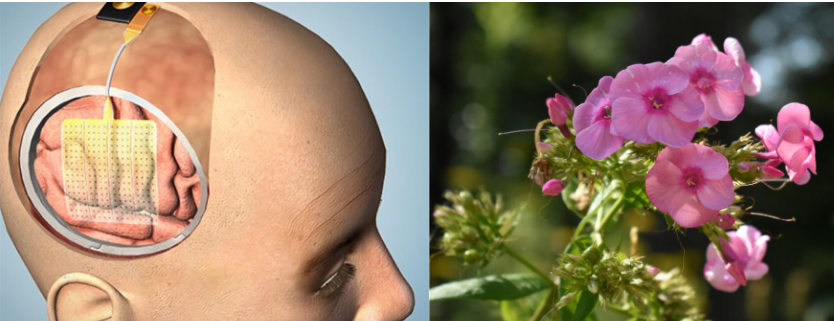
Just in time for my tenth near-death-iversary, I read about the latest pre-surgery brain mapping technique developments, which have advanced significantly since my surgeries. Dr. Ahmed Rasian, a neurosurgeon at Oregon State University is working closely with engineer Shadi Dayeh to develop this new device. The flexible saranwrap like film, which bristles with tiny sensors, rests on the brain’s surface during surgery and is designed to help neurosurgeons remove diseased tissue while preserving important functions like language and memory. During an operation, surgeons place a grid of sensors on the surface of an awake patient’s brain, taking care not to tear the delicate film. Then they ask the patient to do tasks, like counting or moving a finger. The technology is similar to sensor grids that are already used in brain surgery (although they were not around in 2014), but the resolution is 100 times higher. “Imagine that you’re looking on a clear night at the moon, then imagine [looking through] a telescope,” said Mr. Dayeh. All I could think was, imagine if my neurosurgeon had had access to this technology back in 2014—I probably wouldn’t have a near-death- iversary! This week, Mr. Dayeh and his team received FDA approval for a clinical trial to test the device’s efficacy.
Dr. Rasian and Mr. Dayeh’s research is part of the federally funded BRAIN Initiative, which was launched in 2014 to develop tools that reveal the brain’s inner workings. Sadly, future progress may slow down, as Congress cut BRAIN Initiative funding by about 40 percent this year. This is disheartening, as these new technologies significantly decrease the chances of a current day brain surgery patient going through the stretched-vein glitch I experienced. The decrease in BRAIN Initiative funding inhibits the possibilities of advancements like these, which could lead to lower quality care.
It’s been almost exactly a decade since my near-death experience, which I describe in my memoir, Seizing Control. Perhaps I would have avoided the experience entirely, had my neurosurgeon had access to this new technology—I’ll never know for sure, of course. I do know that not a day goes by when I don’t acknowledge how lucky I am to be alive, and how blessed I am to have the uncontrolled seizures finally behind me. As somebody who underwent a glitchy brain surgery before these technologies existed, I can assure you that this progress is critical. My fingers are crossed for a good outcome on the FDA clinical trial. I’m grateful the device was created prior to the Congressional funding cut and I hope the National Institute of Health finds another source of support.


Well done, Laura. You’re somehow able to talk about serious illness in a strong and optimistic voice
Thanks, Bev. The piece is far better, thanks in part to Page Sixer feedback, like yours.
I was recommended this website by my cousin I am not sure whether this post is written by him as nobody else know such detailed about my difficulty You are wonderful Thanks
I do not write a ton of remarks, howqever i did a few searching and wound up
here #Anniversaries andd Advancements – Laura Beretsky.
And I actually do have a couple of questions for you if you usually do not mind.
if yyou are writing on additiojal online sites,
I’d like to follow anything new you have to post.
Could you list of the complete urls of your community pages like your
linkedin profile, Facebook page or twitter feed? https://Lvivforum.pp.ua
Hi, I don’t want to comment on others’ intelligence, but I do appreciate your chiming in. In addition to my website, I post the same blog on several epilepsy-focused FB pages, including Epilepsy and Seizure Support Group, Epilepsy Awareness, Epilepsy/seizure Support and Discussion, Now What Epilepsy Support Group, Epilepsy Support Group, and Epilepsy Global-Chat, Support, Advice. This is not a comprehensive list of all the FB groups, by any means. The FB pages can be a good place to connect to others with epilepsy from all over. Contributors ask questions of/share personal stories with each other and often several page members respond. How helpful the responses are vary, but some folks are insightful. I’ll chime in on the pages when I think I have a relevant experience that might be useful.
Ridiculous story there. What happened after? Thanks! https://Www.delphican.com/showthread.php?tid=2340
Took a year to recover from that second brain surgery, the emergency craniotomy. But in the end it was fine. I’ve been seizure-free almost nine years now, which has been great. The details are all in my book, if you want to learn more.